Product Information
RTJ Ring Joint Gasket
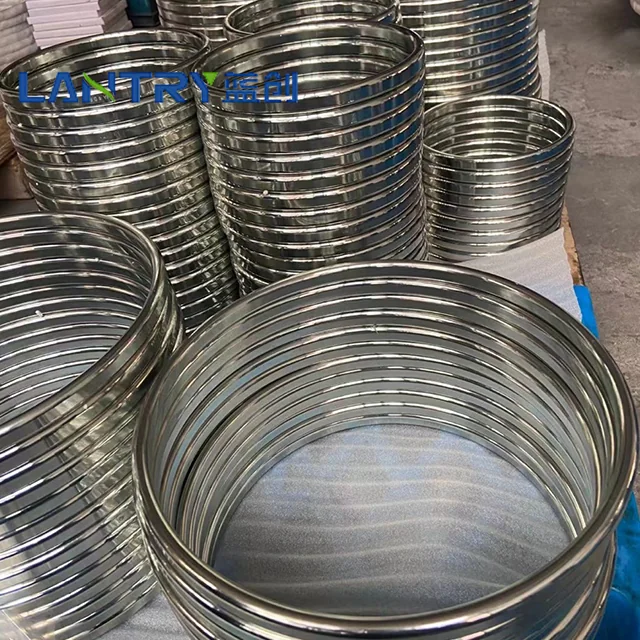
Octagonal ring joint gaskets are metal rings used for sealing high-temperature, high-pressure pipelines and equipment through surface contact.
Types and Pressure Ratings
Type R: The source lists up to 10,000 PSI (approximately 689 bar), compatibility with ANSI B16.5 flanges and reusability.
Type RX: The source lists up to 700 bar, compatibility with R-type flange grooves and suitability for pressure fluctuations.
Type BX: For API 6A BX flanges and very high-pressure service, including oil and gas wellheads. The source lists 15,000 PSI and approximately 1,500 bar; these values are reproduced as separate source figures.
Sealing Principle
The octagonal cross-section contacts the trapezoidal flange groove over a surface rather than the line contact of an oval ring, filling microscopic gaps.
Medium pressure promotes radial expansion and increases contact pressure, creating a semi-self-energizing seal.
The source describes a 23° bevel, pressure resistance up to 42 MPa (approximately 420 atmospheres) and stability at 800°C.
Materials and Properties
Materials include carbon steel, stainless steel 304/316/316L and alloy steel. Hastelloy and Monel may be selected for special conditions.
The source gives a temperature range of -196°C to 1,000°C, with special alloys such as Hastelloy suitable above 800°C.
Gasket hardness should be 15–20 HB below the flange face to avoid damage. The source lists typical 304 stainless steel hardness of 160–200 HB.
Selection and Installation
Match the type to pressure and temperature changes: BX for very high pressure and RX for pressure fluctuations.
Check that gasket hardness is lower than flange-face hardness.
Keep flange grooves clean and free of scratches. The source specifies Ra 3.2–6.3 μm surface roughness and uniform bolt preload.
Applications
Oil and gas wellheads and high-pressure steam pipelines.
Nuclear power valves, deep-sea oil wells and other demanding environments.
Chemical equipment, heat exchangers and pressure vessels.
Comparison with Oval Rings
The source describes octagonal rings as providing surface contact, compared with line contact and lower preload for oval rings.
It lists reuse 3–5 times for octagonal rings and secondary tightening for oval rings.
It reports approximately 15% lower machining cost for octagonal rings; oval rings require curved-surface machining.
Selection should focus on profile compatibility and hardness control.